
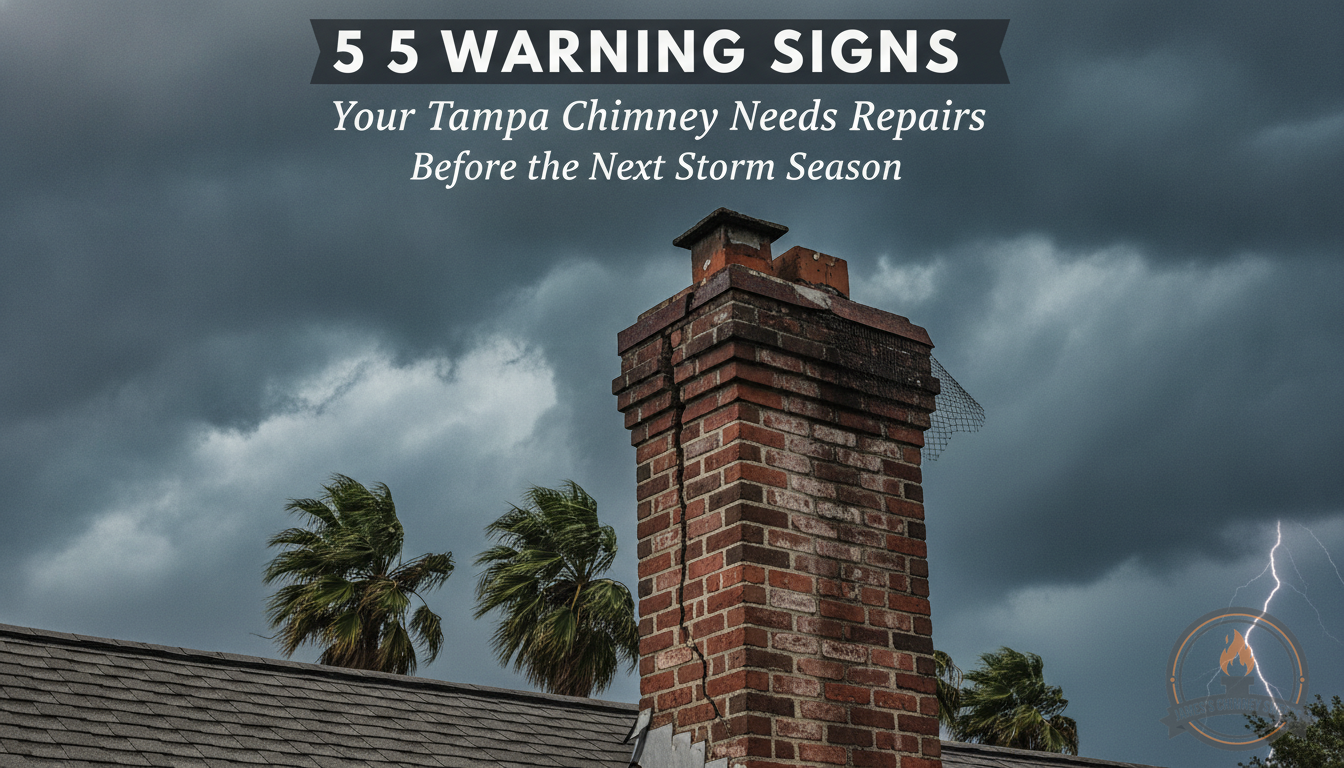
Tampa's summer storm season is one of the most intense in the continental United States. From June through September, the Tampa Bay area receives the bulk of its annual rainfall, with frequent lightning storms, high winds, and hurricane threats that can punish poorly maintained chimney structures. By the time most Tampa homeowners think to look up at their chimney, the damage has often been building for months — or even years.
At James's Chimney Sweeps, we inspect and repair chimneys throughout Tampa and Hillsborough County year-round. Here are the five warning signs we see most often that indicate a chimney is overdue for professional chimney repair — and what happens if you ignore them.
1. White Staining on the Exterior Brick (Efflorescence)
That chalky white powder or streaking on the outside of your chimney isn't just cosmetic. It's called efflorescence, and it's one of the clearest signals that water is actively moving through your chimney's masonry. As moisture migrates through the brick and evaporates on the surface, it deposits mineral salts behind. Efflorescence itself is relatively harmless, but the water causing it is not — that same moisture is dissolving mortar, expanding inside micro-cracks, and weakening your chimney's structural integrity with every rain cycle.
Tampa homeowners who notice white staining should schedule a professional chimney inspection promptly. In many cases, the issue can be addressed with targeted mortar repair and a professional-grade chimney waterproofing treatment before more serious damage occurs.
2. Spalling Bricks
Spalling refers to the flaking, chipping, or crumbling of brick faces — and it's a direct consequence of freeze-thaw cycles and sustained moisture intrusion. While Tampa doesn't experience the hard freezes common in northern states, our occasional cool spells combined with high humidity are enough to cause brick surfaces to deteriorate over time. You may notice brick fragments at the base of your chimney or on the roof, or you may see pits and rough surfaces where the brick face has broken away.
Spalling bricks weaken the chimney's overall structure and expose fresh, unprotected masonry surfaces to further moisture damage. Left unaddressed, spalling can progress to the point where entire sections of the chimney require rebuilding — a significantly more expensive repair than early-stage tuckpointing. Our chimney repair team handles spalling through a combination of brick replacement and mortar joint restoration using materials rated for Tampa's climate.
3. Crumbling or Missing Mortar Joints
The mortar between your chimney's bricks is not decorative — it's structural. Mortar joints hold the entire masonry assembly together and create a weather-resistant barrier that keeps water from penetrating deep into the chimney structure. Over time, Tampa's humidity, UV exposure, and thermal cycling cause mortar to dry out, crack, and crumble away.
When mortar joints fail, water enters freely. In a worst-case scenario, deteriorated mortar can allow the chimney to shift or lean — a condition that poses both a fire risk and a structural liability for your home. Tuckpointing (the process of removing deteriorated mortar and replacing it with fresh compound) is one of the most common and effective chimney repairs we perform in the Tampa area. It's also one of the best investments a homeowner can make in the long-term health of their chimney.
4. Water in the Firebox After Rain
Finding water pooling in your firebox or on your hearth after a rainstorm is a clear sign that water is entering the chimney system somewhere it shouldn't be. Possible entry points include a missing or damaged chimney cap, a cracked chimney crown, failed flashing where the chimney meets the roof, or deteriorated mortar and brick on the chimney's exterior.
Water inside the firebox damages the refractory panels and mortar joints that line the combustion area, can rust your damper, and introduces moisture into the flue liner — all problems that compound quickly if not addressed. If you're seeing water after storms, don't assume it will resolve itself. A chimney inspection will identify the exact entry point so the right repair can be made. For many Tampa homeowners, the solution involves installing or replacing a chimney cap combined with crown repair and waterproofing — all services James's Chimney Sweeps can complete in a single visit.
5. A Damaged, Cracked, or Missing Chimney Crown
The chimney crown is the concrete or mortar cap that seals the top of the chimney structure around the flue opening. It's designed to shed water away from the chimney's masonry and prevent rain from running directly down between the flue liner and the chimney's exterior walls. A properly built crown slopes slightly downward from the flue liner outward to the chimney edges — directing water off the chimney rather than into it.
In Tampa's climate, chimney crowns endure intense UV radiation, thermal expansion and contraction, and heavy storm rainfall. Hairline cracks are common in older crowns and can quickly widen into full separations that allow gallons of water to enter the chimney during a single storm. If you can see visible cracking, chunks missing from the crown surface, or separation between the crown and the flue liner, it's time to call for repairs. James's Chimney Sweeps rebuilds and repairs chimney crowns throughout the Tampa Bay and Hillsborough County area, using weather-resistant materials designed to hold up through Florida's storm seasons.
Don't Forget the Inside: Firebox and Flue Liner Damage
While the five warning signs above are often visible from the ground or during a basic walkthrough, some of the most serious chimney damage is hidden inside the flue. Cracked flue tiles, deteriorated liner sections, and smoke chamber gaps require a professional camera inspection to detect. These interior issues are just as dangerous as exterior deterioration — a cracked liner can allow combustion heat and gases to contact surrounding building materials, creating a serious fire and carbon monoxide risk.
If your firebox shows cracked refractory panels, crumbling mortar between firebricks, or visible damage to the smoke chamber walls, our fireplace and firebox repair service addresses these issues using high-temperature refractory materials rated for the demanding heat environment inside a working fireplace.
Act Before Storm Season — Not After
The best time to address chimney repairs in Tampa is before the summer rainy season begins — ideally in the spring when dry conditions make mortar applications and sealant work most effective. The worst time is after a major storm has already driven water through cracks that a repair visit two months earlier could have sealed.
James's Chimney Sweeps serves homeowners across Tampa and surrounding communities including Riverview, Carrollwood, Town 'N' Country, and Gibsonton. We're available Monday through Sunday
Questions about chimney in Tampa, FL? We're happy to help — no sales pressure.
Talk to a Local Pro
Call +18133367890 or fill out our online form for a free, no-obligation quote.
Request Free Quote